Somewhere along the way, ordinary life became content.
A coffee before work. A birthday dinner. A new relationship. A holiday. A bad day. The view from a train window. Moments that once might have been experienced, remembered, photographed and perhaps shared with a few people can now be published to hundreds or thousands within seconds.
There is nothing inherently wrong with that. Social media has given people communities, careers, friendships, opportunities and, for some, an income. It has allowed ordinary people to tell their own stories instead of waiting for someone else to tell them.
But it also raises a quieter question.
How much of our lives do we want to remain ours?
When almost any moment can become a post, Story, Reel or update, the boundary between a life being lived and a life being documented becomes harder to see.
And perhaps the question is no longer whether we share online.
It is whether, years from now, we will wish we had kept a little more for ourselves.
When Everyday Life Became Content
There was a time when most ordinary moments simply disappeared into memory.
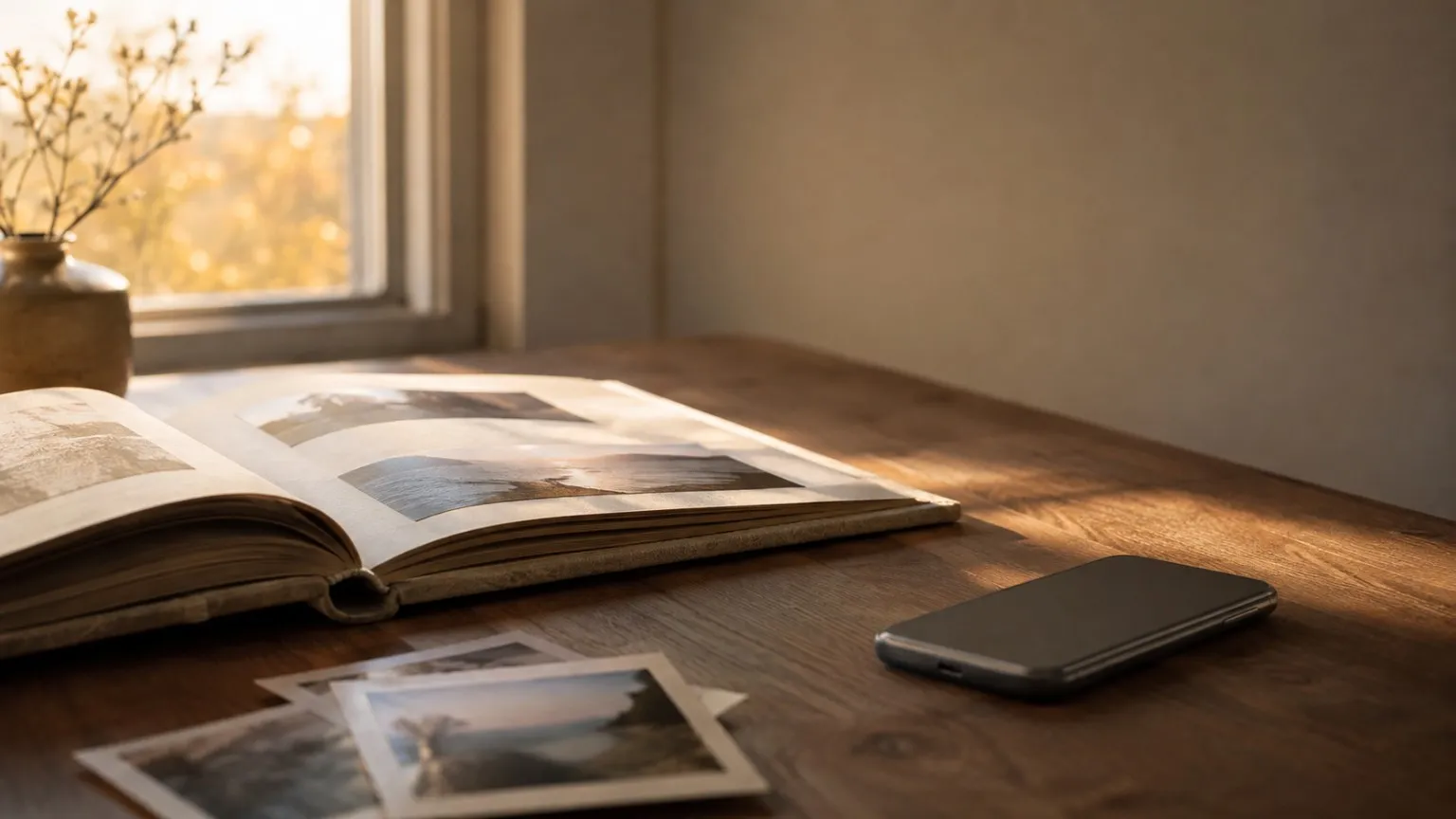
You might take a photograph on holiday, print it months later, place it in an album and show it to someone when they visited. A meal could be enjoyed without being photographed first. A relationship could exist without appearing online. A difficult day might be discussed with one trusted person rather than announced to an audience.
Social media changed that slowly, then all at once.
The phone in our pocket became a camera, diary, publishing platform and audience at the same time. Sharing stopped requiring much effort. If something happens, we can document it almost immediately.
That convenience has brought genuine benefits. Families separated by distance can remain connected. Small businesses can reach customers without enormous advertising budgets. Artists, writers and creators can build audiences from their homes. People who once felt isolated can find communities that understand them.
But the habit of sharing can also change the way we experience a moment.
Sometimes we are no longer simply asking, “Am I enjoying this?”
We are also asking:
“Should I post this?”
A beautiful meal becomes potential content. A weekend away becomes a collection of Stories. A new purchase becomes an update. Even difficult experiences can become something to package, caption and share.
None of this means posting is inherently superficial.
The more interesting question is whether constant documentation quietly changes what we consider private — and whether we notice that change while it is happening.
The Trade: Visibility in Exchange for Privacy
For many people, sharing online is not simply about attention.
Visibility can create real opportunities.
A creator can turn an audience into an income. A photographer can find clients through Instagram. A small business can reach customers through TikTok or Facebook. Someone sharing their experience of living abroad, changing careers or raising a family might build a community around something that once felt private.
That is part of what makes the modern internet so powerful.
But visibility has a cost that is harder to measure.
Every time we share something personal, we make a small decision about what other people are allowed to know about us.
Our routines.
Our relationships.
Where we spend our time.
What we buy.
Where we travel.
What our homes look like.
Sometimes even what we are feeling at a particular moment.
One post may reveal very little. Hundreds of posts across several years can reveal much more.
And when sharing becomes connected to income, the boundary can become even more complicated.
If people follow you because they feel they know you, how much of yourself do you continue giving them?
If a personal moment performs well, does that make you more likely to share another one?
If your private life becomes part of what attracts an audience, where does the content stop and the person begin?
There is no single correct answer.
Some people are comfortable sharing widely. Others deliberately keep large parts of their lives offline. Most of us probably sit somewhere between the two.
But perhaps privacy is no longer something we simply have.
Increasingly, it is something we have to choose.
The Internet Remembers Differently Than We Do
People change.
What feels important at twenty-five may feel irrelevant at thirty-five. Relationships begin and end. Careers change. Opinions develop. The person who posted something years ago may no longer recognise themselves in it.
But the internet does not grow with us in the same way.
An old photograph can remain searchable. A forgotten comment can be screenshotted. A post deleted from one place may already have been copied somewhere else. Something shared casually with a small audience can sometimes travel much further than intended.
That creates a strange imbalance.
We are allowed to change our minds, but our digital history can continue presenting older versions of us.
There is also the question of context.
A photograph that made perfect sense among friends at one point in life may look very different to a future employer, partner, customer or stranger who knows nothing about the circumstances around it.
And sometimes the concern is not embarrassment at all.
It is simply the feeling that something which once belonged to a particular moment — a relationship, a home, a child’s childhood, a vulnerable period of life — remains publicly accessible long after we would naturally have stopped talking about it.
Before social media, many memories faded quietly or stayed within relatively small circles.
Now some of them can remain available indefinitely.
Recent UK research suggests people may already be becoming more cautious about what they leave online. Ofcom’s 2026 research found that 49% of adult social media users were concerned that something they posted could cause them problems in the future, up from 43% previously. It also found that posting and commenting on social media had fallen from 61% to 49%. That does not necessarily mean people are abandoning social media, but it may suggest that some are thinking more carefully about what deserves to become part of their permanent digital record.
Perhaps future regret will not always come from posting something obviously reckless.
It may come from realising that we shared pieces of ourselves before we understood how permanently public they could become.
Are We Documenting Our Lives — or Performing Them?
There is a subtle difference between remembering a moment and preparing it for an audience.
Once we know something may be posted, we can begin to experience it differently.
We might choose the table with better light. Take several versions of the same photograph. Rearrange something before capturing it. Wait before eating because the meal has not been photographed yet. Visit a place partly because we know it will look good online.
None of these things are necessarily harmful.
People have always cared about presentation. We dress differently for certain occasions, choose what photographs to keep and tell stories in ways that make sense to other people.
Social media simply gives that instinct a much larger stage.
But when an audience is always potentially present, even when physically we are alone, it becomes worth asking whether that audience starts influencing the experience itself.
Would we have photographed this if nobody could see it?
Would we have bought it?
Would we have gone there?
Would the moment have felt just as meaningful if it stayed completely private?
Sometimes the answer will still be yes.
Sometimes it may not.
Perhaps the important thing is not to stop documenting life, but to occasionally experience something without immediately deciding what it should become online.
A meal that is just a meal.
A holiday moment that never becomes a Story.
A conversation that belongs only to the people who were there.
A memory that does not need proof that it happened.
There can be something quietly valuable about knowing that a moment existed — even if nobody else ever sees it.
Could Privacy Become the New Luxury?
For years, visibility has been treated as a kind of currency.
More followers. More views. More access. More people knowing your name.
Being seen can create opportunity, influence and income. For some people, building a public identity online has opened doors that would once have been difficult to reach.
But it is possible that the value of privacy is beginning to move in the opposite direction.
When almost anyone can publish where they are, what they are doing, what they bought, who they are with and how they feel, choosing not to reveal something can start to feel unusual.
A private holiday.
A relationship that exists almost entirely offline.
A home that strangers have never seen.
A celebration without photographs posted in real time.
An achievement shared only with the people who matter most.
These things can begin to feel almost luxurious precisely because they are becoming less common.
Privacy offers something visibility cannot always provide: the freedom to experience a part of life without wondering how it will be interpreted, measured or reacted to.
There is no audience to impress.
No algorithm to satisfy.
No need to explain why a moment mattered.
And perhaps that is why privacy may become increasingly valuable in a world where attention is constantly being bought, sold and competed for.
The next status symbol may not be having millions of people watching your life.
It may be having a life with parts that millions of people know nothing about.
What Might Be Worth Keeping Private?
The answer will be different for everyone.
Privacy is not about disappearing from the internet or refusing to share anything personal. It is about deciding which parts of life should remain yours before the decision is made for you.
The UK Information Commissioner’s Office also recommends reviewing who can see your posts and checking which apps and devices can access information such as your location — useful reminders that online privacy is partly shaped by the choices we make before we share.
That might mean thinking more carefully about things such as:
- your exact location while you are still there
- routines that make your movements predictable
- information about children who are too young to decide what should be public
- arguments, break-ups or vulnerable moments that are still unfolding
- financial details and expensive purchases
- private conversations involving other people
- photographs of someone who has not agreed to be posted
- the inside of a home in enough detail to reveal more than intended
- personal information that could later be used to identify, impersonate or target you
But there is another category that has nothing to do with security.
Some things may simply be worth keeping private because privacy changes the experience of them.
A new relationship can develop without strangers commenting on it.
A personal goal can grow quietly before it becomes an announcement.
A difficult period can be processed before it becomes a story.
An achievement can feel meaningful without being measured by the number of people who react to it.
And a memory can remain important even if there is no public record of it.
Before posting something, perhaps the most useful question is not:
“Is this safe to share?”
It might also be:
“Do I actually want this to become public?”
Those are not always the same question.
Perhaps Not Everything Needs an Audience
Social media is not going away, and perhaps it should not.
It has made it easier to stay connected across countries, discover ideas, build communities, find opportunities and create businesses that might never have existed otherwise.
The question is not whether we should stop sharing.
It is whether we still remember that we are allowed not to.
Not every meal needs to become a photograph.
Not every holiday needs to be documented while it is happening.
Not every relationship needs an audience.
Not every achievement needs public approval.
Not every difficult moment needs to become a story before we have even understood it ourselves.
There was something different about the older way of keeping memories.
Photographs lived in albums. Stories were told around tables. Some moments became family stories, while others disappeared quietly into the past.
We gained something extraordinary when our lives became easier to share.
But perhaps we also gave something away without noticing.
The ability to experience a moment knowing that it belongs only to us.
Maybe privacy will not disappear.
Maybe, after years of documenting almost everything, we will begin choosing it again.
And perhaps one of the most meaningful things we can say about a moment in the future will be:
Nobody online knows about this one.
And that is exactly how I wanted it.